Back To The Truth: 5000 Years Of Advaita
Contents:
That Elixir Called Love: I Is A Door: Visions of Awakening Space and Time. Verses from the Center. The Wheel of Life. Natural Appearances, Natural Liberation.
- The Confessions of A Frustrated Preacher;
- Orson the Kid. Escuela de cine para niños. Doce Guiones cinematográficos escritos y realizados por n.
- Back to the Truth : 5000 Years of Advaita by Dennis Waite (2007, Paperback).
- The Flipside!
Handbook for the Spirit. Meditations on Living, Dying, and Loss. Fully Human Fully Divine: Awakening to our Innate Beauty through Embracing our Humanity. Awakening to the Spiritual Essence in Yourself and Others. An Introduction to Buddhism. The Book of One. Western Philosophy Made Easy. How to write a great review. The review must be at least 50 characters long.
The title should be at least 4 characters long. Your display name should be at least 2 characters long. At Kobo, we try to ensure that published reviews do not contain rude or profane language, spoilers, or any of our reviewer's personal information. You submitted the following rating and review. We'll publish them on our site once we've reviewed them. Item s unavailable for purchase. The second uniqueness of the book is the large spectrum of its coverage.
Back To The Truth: Years Of Advaita - Dennis Waite - Google Книги
The secondary title of the book, " years of Advaita" is amply justified by this coverage. The first chapter looks at who we are not. We are neither the body nor the mind. The second chapter is about action, Karma, reincarnation and free will. What is the motivation for action? It is pursuit of happiness. Desire, motivation and purpose form therefore the subject of discussion. Then comes the difficult portion of advaita: The various spiritual practices advocated in order to prepare the mind on its spiritual ascent are examined in the next chapter, which is the longest.
Chapters 6 and 7 take up the core of advaita: This listing of the chapters cannot however do the least justice to the extent and depth of topics dealt with in these seven chapters. The author takes the reader leisurely through the labyrinths of advaita step by step through all these discussions - now quoting a scripture, now excerpting from a modern writer, now interposing with his own synopsis of the argument, now prefacing a difficult logical breakthrough by an introduction, and now reproducing a whole passage from Ramana or Shankara or Ramesh Balsekar or any of the hundred or so authors he quotes with conviction.
Want to Read Currently Reading Read. The book presents an array of widely open widows and peepholes - profound quotes from the lofty Upanishads, wisdom coming down from ancient as well as modern teachers and miscellaneous Advaitic tidbits collected from present day electronic debates. Item s unavailable for purchase. The traditional teachers say work is indeed needed by preparing the mind through meditation, learning the knowledge that will cure you of your ignorance that's blocking you to see your inherent enlightenment, and to find a good guru to help you with your own self inquiry. To pursue experience is natural but to pursue it at the expense of understanding is foolish because it is only misunderstandings about our true nature that make us think we are unenlightened in the first place. Your book is like finding a mine filled with all sorts of glittering gemstones. The Yoga Sutras of Patanjali.
We get to go through the difficult terrains of pancha-kosha-prakriyA methodology through the five sheaths , bhAga-tyAga-lakshhaNa pointer through the giving up of contradictory parts , dRshhTi-shRshhTi seeing is creation , adhyAropa-apavAda denial of erroneous attribution and such concepts galore. Think of anything in the advaita terrain, it is there, -- with all the distinction of precision and scholarship. The first one goes back to the scriptures and all the commentaries. The second one, the Direct Approach, is somewhere in between the other two.
And fourthly - this is really a superlative uniqueness - in order to help all those who are unfamiliar with the Sanskrit script or language, there is a page brief introduction to the script and pronunciation as well as to the transliteration of Sanskrit writing. Several other excellences are worthy of being highlighted. A pointwise bulleted summary at the end of each chapter helps the reader not to miss the wood for the trees. In sum, this landmark book provides an enjoyably pleasant reading, inspite of its necessarily heavy content.
It should be in the hands of every spiritual seeker, whether of the advaita school or not. Ever since I picked up Back to the Truth, I've hardly been able to put it down! There is something of real interest and substance on almost every page. I feel a great service has been done for the cause of truth through your authorship and I thank you for being so fully available for what was obviously an enormous and comprehensive task.
What is Kobo Super Points?
Peter Sumner, Gurukula Books. A Gift of Grace - Well, finally, a flawlessly researched, complete and brilliantly articulated view of the seeming contradictions and many paradoxes in the Teachings of Nonduality. This scholarly Work resolves the issues of this path vs. This fascinating tome is a must for any serious student of Advaita. Dennis dispels many myths, exposes the fallacies of certain concepts about "right paths," and importantly, exposes the folly of belief in the idea that "there is nothing to do" as an incomplete pointing to Truth.
Clearly, the author must BE what he is pointing to. I find this work to be one of the most liberating of the many, many books I have read on the subject. Thanks for this Font of Grace, Dennis. A valuable resource for anyone interested in Advaita at any level. Dennis covers every aspect of the subject, incorporating writings from teachers ancient to modern.

An academic treatment of an enormous amount of material, while preserving the magic and beauty of the message. Nothing like this book exists, and it is destined to become a "must-have" for students and teachers. This is an extraordinary book. The scope represents a real tour de force in marshalling and laying out an encyclopaedic amount of material in way that will appeal both to the seasoned and to the introductory reader.
This book will surely be the definitive work of reference for many years to come. This is one of the best books on Advaita I have seen. I would recommend it to anyone interested in Advaita as a must-have. In fact, would heartily recommend it to anyone who is a seeker of truth. At last, the book you have been searching for Reviewer - Advaita Rules - Australia. This book is a comprehensive compilation explaining clearly for a western audience the practical teachings of Advaita, these teachings have stood the test of time and rightly so. For those that would like a bit more guidance than "you are that", this IS the book.
Join Kobo & start eReading today
This book will make sense of the various teachings you may have already encountered, put them in perspective, clear confusion and correct misdirection. This book explains the direct path and how it works. Knowledge is everything and here you will find the knowledge that provides clear pointers back to the truth of that which you truly are. Non-duality, Advaita and Zen are all at home here and the material is supported by a massive amount of quotes from modern and traditional sages and teachers.
This is an excellent read, a substantial resource and I am sure will remain amongst my favourites. I felt that I really must contact you to express my admiration of such an erudite and scholarly, but at the same time very readable, work. It is particularly valuable to have traditional Advaita teachings compared and in some cases, contrasted! When I read his previous work "The Book of One", I thought he had exhausted himself, for he had said in it, so it seemed to me then, all that there was to be said about Advaita.
Besides, Advaita being all about the secondless One, I had been silly enough to think that not much can be written about it and plurality of words was rather counter-productive. Dennis has proved me utterly wrong with another riveting classic.
- .
- Back to the Truth : Years of Advaita by Dennis Waite (, Paperback) | eBay.
- ?
- Ecco la marcia, andiamo!, No. 22 from Le Nozze di Figaro, Act 3, K492 (Full Score);
- Back to the Truth!
- Proceedings of the Sixth International Conference on Number Theory and Smarandache Notions.
Well, we have been talking about Advaita for over years. Dennis has made good case and cause of it. His approach is all-encompassing and meticulous. The result - a Herculean success palatable to the traditionalists as well as the neos. Dennis provides the right blend for the West and East, mixing apparently divergent ideas drawn from sources as far apart as Shankara and Nathan Gill.
That indeed is some commendable expertise.
- Romanno Bridge.
- See a Problem?.
- 1 679,50 RUB.
- The Rise of Modern Yiddish Culture (Pitt Russian East European)?
- The Gladiators Woman.
- Seeker (The Noble Warriors Trilogy)!
- Back to the Truth: Years of Advaita by Dennis Waite.
The reader enjoys a scholarly reconciliation of different schools of thoughts served on the silver platter of simple language - an endeavor never attempted by any of our scholarly authors before. Dennis's personal exchanges with some of the profound minds of the present day add addictive flavor and aroma to the recipe.
The book presents an array of widely open widows and peepholes - profound quotes from the lofty Upanishads, wisdom coming down from ancient as well as modern teachers and miscellaneous Advaitic tidbits collected from present day electronic debates. When Dennis pushes your neck through them, you simply can't fail to discover the Truth. The effect is kaleidoscopic and colorful; yet, the revelation is unmistakably that of One! The bibliography, references and teacher lineage charts are an excellent guide to students of Vedanta.
These represent very exhaustive improvements and updates on information previously provided in "The Book of One". Dennis has also been very considerate to provide accurate transliteration keys and a very helpful glossary of Sanskrit terminology.
Readers are thus assured that their steps don't falter as they traverse the wide vistas of Vedanta he opens up before them. All interested in Vedanta and libraries across the world must go and get a copy of this. Dennis Waite aka [.. It is insightful to see "I do nothing" and yet, there ARE practices that are helpful if one really wants the truth in an uncompromising and undiluted way.
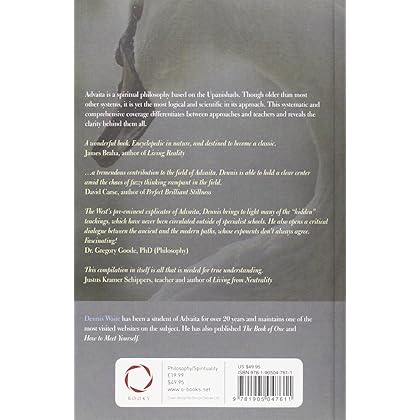
Back to the Truth: years of Advaita [Dennis Waite] on donnsboatshop.com *FREE* shipping on qualifying offers. Advaita is a spiritual philosophy based on the. Editorial Reviews. Review. A wonderful book. Encyclopedic in nature, and destined to become Back To The Truth: Years Of Advaita by [Waite, Dennis].
I feel refreshed, educated, and empowered, after years of reading "neo-Advaita" teachers who are wonderful, yes, but who don't give the practical tools that us seekers really, truly are seeking. We can rephrase this all we want and still we want the truth. This book has helped me to stop denying the fact that I am earnest enough to be willing to do what needs to be done for the awareness of truth to undo the obstructing tendencies, rather than to just see these obstacles as 'what is' and 'do nothing' without looking deeper into what this actually means.
I will also add that it is a wonderful book even for people who are curious to learn about the philosophy of Advaita in a comprehensive way, but who might not be 'seekers'. I would recommend this book to my friends who might be turned off by the books that leave out certain steps of logic.
The spiritual and the skeptical can both find help here. Being a student of Advaita non-duality Vedanta the culmination of The Vedas can be a daunting task for the western student. To ask other readers questions about Back to the Truth , please sign up. Lists with This Book. This book is not yet featured on Listopia. May 14, John rated it it was amazing. If you're interested in spirituality, enlightenment, Hinduism, non-duality - look no further. This page epic pulls upon the Upanishads bringing clarity to the confusion that is usually found when diving into the topic of non-duality.
Back to the Truth: 5000 Years of Advaita
How Waite does this is he pulls multiple gurus together in this book critically comparing their teachings, classifying them as Traditional Advaita, Direct Path and Neo-Advaita. He attempts to be as comprehensive as possible pulling quotes from as many teachers a If you're interested in spirituality, enlightenment, Hinduism, non-duality - look no further.
He attempts to be as comprehensive as possible pulling quotes from as many teachers as possible, from Ramana Maharshi to Greg Goode to Tony Parsons and compares them all. Clarity such as this book is rare within the subject of non-duality. Within his comparisons he shows you where they differ, such as the newer neo-advaita teachers claim that there is no work to do to reach enlightenment as you are already unknowingly enlightened.
The traditional teachers say work is indeed needed by preparing the mind through meditation, learning the knowledge that will cure you of your ignorance that's blocking you to see your inherent enlightenment, and to find a good guru to help you with your own self inquiry. The direct path teachers claim self inquiry is all that is needed. It now all becomes clear that as the neo-advaita teachers say that there is nothing for you to do to achieve enlightenment, it's not going to happen by chance. Waite pulled upon the example of Einstein where his ideas wouldn't have come to him if he did not prepare the mind for the ideas in the first place.
One of the cons of this book though is that in the attempt to be as comprehensive as possible, some parts of the book become slow and difficult to get through. I only encountered this twice whereas the rest of the book was a joy to read. Another con is that he uses a lot of Sanskrit so wrapping your head around new words becomes a chore and is usually skipped. A helpful tip to avoid confusion when reading this book, is that in the subject of non-duality, authors use the words Self and self a lot.
Self means the total, impersonal, larger self of oneness. Lower case self means the little me that we mostly believe us to currently be. Apr 13, Amijoy rated it it was amazing. After many years of reading books on advaita, listening to teachers of various shades of advaita, participating in the labyrinthine discussions with other advaitins Back to the Truth snapped into place so many missing, or misplaced, pieces of the puzzle for me.
I read it cover to cover, which I believe is recommended by Waite. I recommend it highly as a clarifying aerial view of the complex Advaita Vedanta landscape. Mar 13, Prabhuram Ramachandran rated it it was amazing.
- Islam: A Thousand Years of Faith and Power (Yale Nota Bene)
- Levinas, Judaism, and the Feminine: The Silent Footsteps of Rebecca (Indiana Series in the Philosoph
- Boys Will Be Boys
- Inventario del General Malo (Spanish Edition)
- A Letter to Mrs. Roosevelt
- Campaigning with Crook, and Stories of Army Life (1890) [ILLUSTRATED EDITION]
- The Traveler and Other Poems