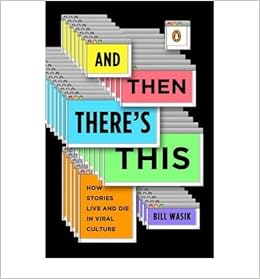
And Then Theres This: How Stories Live and Die in Viral Culture
Contents:
Jul 29, Ihancock rated it liked it. As I read this book I often had moments of reflection, interest, confusion, skepticism; in fact, I felt pulled in many different directions. This is, I guess, to be expected when the book describes itself as part memoir, part field report, part manifesto, and part deconstruction of a decade.
I found the book initially to get into for this very reason. However, as the book went on, either I became more acclimatized to the editing and writing style or the book became clearer at defending its thesi As I read this book I often had moments of reflection, interest, confusion, skepticism; in fact, I felt pulled in many different directions. However, as the book went on, either I became more acclimatized to the editing and writing style or the book became clearer at defending its thesis.
I am not sure that I agreed with the authors assertion that the rise of memes coincides with the rise of boredom and or the increasing "multitasking" brain. I more think that it is a symptom of a society that has learned that it can have a voice and that sometimes this voice gives rise to someone that others want to seek out and connect with.
And Then There's This: How Stories Live and Die in Viral Culture [Bill Wasik] on donnsboatshop.com *FREE* shipping on qualifying offers. An odd but happy marriage. Full disclosure: Bill Wasik is a friendly acquaintance with whom I socialize once every years (according to the leather-bound social diary in my mind).
This used to be the realm of professionals but more than ever it is amateurs who seek each other out and confer this status on each other. This is more than boredom. It is people who want to bask in popularity; want to go for that moment of fame which is altogether more possible in the internet world.
However, there were many moments I did agree with including the rapid rise and fall of stories or websites as people find the "next big thing" then move on as the site becomes crowded and no longer new. I myself know this feeling as someone who has excitedly been involved in a website ad it began and am now feeling like my contributions are being lost as the site grows in users. Maybe but when new web 2.
And Then There's This How Stories Live and Die in Viral Culture
I also agreed with the author about the need to reach out beyond what we feel agrees with our opinions. The Internet has made this far to easy but it will be a challenge to overcome for precisely the reasons given by the author. All in all, a good book; interesting anecdotes, difficult to get into to start with but easier if you stay with it. As with most of these books I also would not purchase it. Will it stay relevant as time goes?
May 09, Jimmy added it. I am reviewing this book from the standpoint of a Christian worldview though the book is not Christian. This is a book about the internet and internet sensation, what today people refer to as something "going viral. What I took away from this book is the fact that things on the internet can come and go at a m I am reviewing this book from the standpoint of a Christian worldview though the book is not Christian. What I took away from this book is the fact that things on the internet can come and go at a much more vicious cycle than in other past culture--one can overnight be an instant celebrity mentioned as a household name and searched on google by millions of individuals in a manner of hours, only to have people forget about you just weeks later, as the internet moves on to other "nanostories.
The book reminded me of the theme from the book of Ecclesiastes in the Bible about "vanity" and how everything moving on and fade like a mist which accurately capture our internet viral age. Even one's legacy is something one can't control especially in the viral culture since events and individuals can easily get imposed upon with a story or spin online to fit a larger narrative something the author discusses.
The book also talks about how this viral culture on the internet has allowed a level playing field of regular people to blog and become a celebrity of sorts in their own rights, and also individuals to be pundits whom in the day of traditional media would have not been able to make an impact of hundreds and thousands of people. Sometimes the mainstream media end up covering the news of what's going online on social media! And no doubt this very review online is an example of that. The author is quite insightful, witty and makes you reflect about the age we live in.
I highly recommend this work--and I don't want to take away from this work, but this book got me thinking about "The Next Story: Nov 27, Becky rated it really liked it Shelves: I know this was a pop-non-fiction book, but I still really liked it. It was a quick read and an interesting analysis of an internet obsessed, fad-driven culture. I find myself a victim to this culture quite often, especially lately. I feel so stressed out in following the popular authors, musicians, or pop culture stories of the day that I don't really catch the substance and the value of culture.
The author devotes a chapter to indie bands and how they have such a short life of popularity becau I know this was a pop-non-fiction book, but I still really liked it. The author devotes a chapter to indie bands and how they have such a short life of popularity because everyone just wants to move on to the next underground band who they can like before everyone else.
He talks about how really good bands just get lost in the shuffle. He made me feel less stressed about keeping up with the newest artists, which is a relief. I think I'm actually quite removed from the culture of bloggers and internet viral culture, which I'm glad about This was a good book.
A quick read covering various topics It was interesting to read about how the internet, blogs, and e-mail forwards are affecting culture in various ways. Nov 04, Heather Denkmire rated it did not like it Shelves: I can't stand giving up on books, but sometimes it doesn't feel like a struggle. I read a review of this somewhere that suggested maybe the problem with the book is the subject matter elusive, fast moving, insubstantial not the book itself.
In any case, I had to mark this "read" to get it off my "to read" or "currently reading" list but have marked it "given up," also. It felt too much like a waste of time.
And no doubt this very review online is an example of that. I first heard about it on Twitter, and in no time at all I was enthralled by the hilarious, personalized videos the Old Spice team was producing in response to commenters. It is also one of the few books on the internet that I thought was both forward-thinking and intellectually honest. A peerless book thus far. Stories spread wildly and die out in mere days, to be replaced by still more stories with ever shorter life spans. So I tried to pick particularly funny stories, or ones that very vividly illustrated the basic concepts that I believe are at work underneath all this viral media.
There's probably irony in here somewhere but I'm not sure where to find it. May 22, Elizabeth rated it really liked it Shelves: This was an oddly fascinating read. Almost ten years in the rear view mirror, Wasik talks about internet culture and social network motivations in a conversation style with 1st person experimentation. Viral in this sense discusses more flash mobs and some early website traffic, classic meme stuff.
If anything, I got a great deal of amusement from the constant references to MySpace the dominate platform for social at the This was an oddly fascinating read. If anything, I got a great deal of amusement from the constant references to MySpace the dominate platform for social at the time and Friendster. The book almost becomes a weird marketing historical reference for digital communications. For people raised with Facebook always being present, there's definitely some perspective to be learned here and I am glad it is captured.
Wasik also personally conducted mini social experiments with Flash Mobs and website content. Not for the sake of profit or monetizing social good, but just to see what would happen. His presentation is interesting from his motivation and solid social experiment design and the reported outcome. The writing style is incredibly readable, and while written with the author as a central figure in much of the text, does not have a sense of ego invested.
It's almost disoriented to read a marketing oriented piece that doesn't have that TED talk enthusiasm pepper through out. Interesting for marketing and psych folks. Jun 17, Rachel rated it it was ok Shelves: The creator of the flash mob discusses that and other experiments in meme-making, suggesting that the present age's obsession with "nanostories" is ultimately detrimental to civil discourse and cultural creativity.
The observations and analysis are interesting, as far as they go, but they don't go very far. While some of the examples he explores are illuminating e. A Rogue Economist Explores the Hidden Side of Everything , the contours of the current cultural situation are not explored in very much depth, and the suggestions offered in the conclusion for resisting viral culture's chronically short attention span are common sense and obvious. I think my chief dissatisfaction with the book is the fact that the author's relationship to his subject matter is confused and confusing.
See a Problem?
He styles himself as a journalist and social scientist in his "experiments" with viral memes, but adheres to the ethical codes of neither profession. If he truly believes that the kind of momentary fascination followed by complete oblivion that attends these nanostories is culturally maladaptive at a mass level, why does he go on contributing to it by deliberately creating communications to feed on these very tendencies? He admits to being drawn in by the addictive thrill of creating a following for one's online projects. We never get a genuine mea culpa for this participation -- it is justified as detached?
The impression one gets of these trends vacillates from enjoyable diversion to neutral cultural condition to destructive force.
And then there's this : how stories live and die in viral culture
An insider's perspective on viral culture could have been a source of increased understanding, but in this case it only leaves the presentation muddled. Nov 08, Chris rated it liked it Shelves: Bill Wasik, inventor of flash mobs, writes about how nanostories have created a new form of life all on their own and how they capture and hold our attention for brief periods of time. The other side to that is also that we are so engaged by this nanostories that we have created a demand for them that is so high that we are distilling the life out of them everytime we view the latest new youtube video.
The development of nanostories does not just relate to youtube videos but also news stories ar Bill Wasik, inventor of flash mobs, writes about how nanostories have created a new form of life all on their own and how they capture and hold our attention for brief periods of time. The development of nanostories does not just relate to youtube videos but also news stories are creating the same pull as viral videos. What was once news of a politicians personal life back in the pages of "Roll Call" of a newspaper, they are now considered to be more important news than what actually counts as real news.
The drive for newspapers producing better articles is not so much the quality but what newspaper has the most emailed news articles. The rank of most emailed is now considered the benchmark of making news; stories that grab peoples attention and send out to their friends.
This book dives into how companies are profitting off of just that one consumer behavior, the need to consume viral information. This can also be attributed to the same effect in high school where, if you didn't know the latest gossip you were left out of the loop. The book is interesting to read at certain points and slow at other times. If you are interested in how nanostories and viral videos work and some cool websites designed to monitor them, then this is a great book to read.
- SANs Demystified.
- .
- Red, White, and Blue (America the Beautiful)!
It will give you a lot of insight into viral marketing and consumer demand for it. Jul 05, Ryan Holiday rated it really liked it. This is a weird book that is difficult to categorize. Not many of tried to do much thinking on how a new generation the public generates and consume media narratives and this is the first book to do a good job advancing the science. It is also one of the few books on the internet that I thought was both forward-thinking and intellectually honest.
I'd like to think I am in front of this field a bit and seen some things that only a small group has thus far. Trust me, it's not all sunshine and ki This is a weird book that is difficult to categorize. Trust me, it's not all sunshine and kittens and I don't think many people have bothered to consider the consequences of what Jeff Jarvis calls "process journalism. It could be The Image for my generation. The notion of process journalism, which I think is a stupid rationalization for lazy reporting - a way for blogs to abdicate responsibility for their actions - the way that we consume the stories we created ourselves like some oblivious ouroboros; all these things are discussed thoughtfully by someone with actual experience in the matter.
In fact, I think it's the first time someone who knew what they were talking about has attempted to do so.

It's short, definitely worth reading. Except it didn't play as comedy, or at least not just as comedy. Appellate judges really were a sort of celebrity to a certain--if small--segment of the population, namely those lawyers who, like Lat, worked in that corner of the profession. These lawyers all avidly read Lat's blog. Few of them had previously thought of their profession as a hotbed of salacious gossip, but once a site had bothered to collect it all and present it in a jaundiced tone, the evidence was indisputable.
During the two years that Lat kept up his blog before he was exposed and stepped down from his day job , Underneath Their Robes not only tweaked its profession but on some level transformed it. The lofty reaches of constitutional law had become infected with the media mind. So it has gone with other subcultures in our viral age, when the Internet--with its worldwide accessibility and infinite capacity for segmentation--has allowed us to connect with farther-flung people who are more and more like ourselves.
Much of the emergent Internet culture is in fact a collection of a wide array of niche cultures, in keeping with the "Long Tail" argument put forward by Wired editor Chris Anderson in his book of that name: Think about the offline publications that have traditionally catered to subcultures: The very way we find these publications, each tucked among a slew of unrelated others, makes us keenly aware of their narrow purview, and one can sense in their pages that they realize this too.
The difference online, where subcultures converse incessantly among themselves in an intense, always-on, inwardly directed banter, is that every crowd comes to talk and think about itself as if it were the center of the entire universe. The most obvious symptom of this shift has been the online democratization of fame--what the technology writer Clive Thompson has dubbed "microcelebrity. On the Silicon Valley gossip blog Valleywag, readers follow the exploits of the young founders of Google and Facebook and of far lesser business figures such as Jakob Lodwick, a marginally successful young web entrepreneur whose chief occupation seems to be seeking microcelebrity in the same manner that Us Weekly stalks Tom Cruise.
Even within user-run communities, fame finds a way of attaching itself to the most provocative members. The New York Times reported that when "DaShiv"--a photographer and popular commenter on the group blog MetaFilter--came to visit New York, three different parties were given in his honor by online associates. But such nanofame is just part of a larger move toward nanostories-- toward more narratives, and more perishable narratives--that has taken place within online subcultures. The reason for this larger shift is simple: If impassioned chatter keeps up for days over the question of whether the forthcoming Corvette engine was unduly copied from a BMW engine--as was the case in early January on Autoblog, the biggest blog for car enthusiasts--it is only because a community that reviews twenty or more "breaking" car news stories in any given day will naturally seize on at least one story a week as earth-shattering.
Moreover, the writers, seeing how readers love squabbles, begin to bake this into their posts: But today, when each subculture gets more niche news than even its fanatics can swallow, members become starved for deeper diversions, and their hit-hungry sites are more than happy to oblige. Not long ago, I spent six months following the niche culture of indie rock--i.
This subculture predates the Internet, to be sure--its lineage stretches back to the hardcore scene of the s, if not before, and as a community it has been perpetuated through the years by a network of college radio stations, rundown clubs, obscure magazines, and boutique record stores. Precisely because of its oppositional roots, indie rock like punk before it had an even more fierce devotion than other niches to its subcultural stars: But the Internet has utterly transformed indie rock, as tracks leaked through MySpace and file-sharing have allowed unknown bands to become overnight subcultural sensations, their uptake and abandonment egged on by scores of popular blogs.
After observing some of these spikes flicker through the hipster hive-mind, I wondered whether I might choose one and attempt, as best I could, to document it as it actually happened. What I found, in the story of a band called Annuals, was a parable not just of fickle indie-rock fame but of a paradoxical new cultural force: I'm just saying, get ready to get sick of hearing about this band. Finding out about important new culture used to depend on whom you knew or where you were. In the indie-rock scene of the s, news spread almost exclusively through word of mouth, through photocopied 'zines often with circulations in three or even two digits , or through low-watt college radio stations.
Today, indie-rock culture remains an underground culture, basically by definition, in that its fans shun mainstream music in favor of lesser-known acts. But now, MySpace, iTunes, and Internet radio make location and friends irrelevant for discovering music. Blogs and aggregators enable fans to determine in just a few minutes what everyone else is listening to that day.
What you know, where you are--these matter not at all. To be an insider today one must merely be fast. Unknown bands become all-too-familiar bands in a month, and abandoned bands the month after that. Get ready, that is, to get sick. As promised, half past ten on the morning of July 18 saw Ryan Schreiber, the founder and editor-in-chief of Pitchfork, place his imprimatur upon the new band, which he likened to "some fantasy hybrid of Animal Collective, Arcade Fire, and Broken Social Scene.
- Miracles for Nick (Dear Fairy Godmother . . . Book 3)!
- The Principles of Horsemanship and Training Horses!
- And Then There’s This.
- ;
Schreiber had essentially launched Broken Social Scene's career when he described their American debut album--which he said in his review that he had found just by "dig[ging] through the boxes upon boxes of promos that arrive at the Pitchfork mailbox each month"--as "endlessly replayable, perfect pop. What makes Pitchfork so powerful is not the size of its readership, which by Web-magazine standards is small--one and a half million visitors each month, only a fraction of whom read the site regularly.
Rather, it is its stature in the firmament of indie-rock blogs as a kind of North Star, a point of reference to be measured against. A glowing Pitchfork review need not be agreed with, but it must at the very least be reckoned with.
In his post about the new band, Schreiber concluded with a wink to his site's clout. Once Pitchfork blesses an act, any mention of that act on other blogs needs to be accompanied by an acknowledgment that one has lagged terribly behind the times. On September 7, Stereogum. Irreverence is not a bad starting point for making sense of the web, and Wasik takes full advantage, pushing buttons and pulling puppet strings. The combination of his restless mind and the explosive new medium yields insights that are provocative and, often, hilarious.
It was a mistake. Bill understands not just how viral culture spreads ideas and scams and energy-drink-purchasing opportunities: It's well-researched, funny, irreverent and addictive. One of those rare books that dissects a cultural phenomenon in a way that resonates. It would begin with a flash mob disrupting business as usual and then die the following day, at a Ford Motor Company 'flash concert' echoing through Boston's New Brutalist downtown.