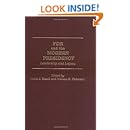
FDR and the Modern Presidency: Leadership and Legacy
Contents:
In this volume Rozell and Peterson bring together a collection of new essays exploring the unparalleled impact of Franklin D. Roosevelt on the modern presidency. Of all the modern presidents, FDR looms largest. Indeed, most scholars date the origins of the modern presidency to FDR, and many assert that no one since has achieved his level of greatness in office. The essays are organized into two broad sections: The first examines FDR's impact on the creation and development of the administrative presidency and the legacy of the New Deal; the second looks at FDR's legacy to presidential leadership and the exercise of presidential powers.
An important volume for scholars and other researchers of the FDR era and the modern American presidency. His six previous titles include Abraham Lincoln: Sources of Style and Leadership Greenwood, Indeed, most scholars date the origins of the modern presidency to FDR, and many assert that Greenwood Publishing Group Bolero Ozon.
Secondary navigation:
In , he went on to Harvard, where he showed as little interest in studies or ideas as he had at prep school. His social life, however, improved dramatically. Franklin was already beginning to display the affability and charm that so bedazzled politicians and the press in the years ahead. Of course, his popularity was helped along by his family name. Cousin Theodore had been elected vice president, and then, in , through the assassination of William McKinley, had become president of the United States. It was only natural that Franklin, already toying with the idea of a career in politics, should pay close attention to the doings of his presidential relation.
Theodore was the first president in the distinctively modern mold: Beyond that, TR, as he was commonly known, had a rare ability to make personal use of popular causes and resentments. Mencken, the great libertarian journalist and close observer and critic of presidents, compared him to the German kaiser, Wilhelm II, and shrewdly summed him up: Particularly fascinating to Franklin must have been the way TR was able to turn his patrician background to his advantage. What TR did brilliantly was to introduce caesarism into American politics.
This term refers to the political strategy adopted by Julius Caesar to gain power. Although himself from a wealthy and high-born family, Caesar castigated his fellow patricians and appealed instead to the lower classes for support. They, in turn, loved the favors they received from on high, and, perhaps even more, the sight of Caesar trouncing and humbling his fellow blue bloods.
In , in a suitably elaborate ceremony, Theodore Roosevelt gave away his niece, Anna Eleanor Roosevelt, to Franklin in marriage. Eleanor proved herself to be an astonishing phenomenon and deserves our close scrutiny in her own right. Anna Eleanor Roosevelt, whom Franklin took as his wife and life-long helpmate, was quite a phenomenon in her own right. In our time, Eleanor Roosevelt as she was always known has become a kind of secular saint, an icon perhaps more sacred than FDR himself.
Hillary Rodham Clinton has claimed Eleanor as her role model if not her personal confidant. Before Eleanor, first ladies might very well have exercised influence behind the scenes; in the unique case of Mrs. But in bygone days, presidential wives as a rule kept a low profile. After all, they had been elected to nothing, nor had they undergone close scrutiny through any process of nomination and confirmation. Eleanor broke decisively with that tradition. Often her stands made news, helping to publicize one or another of her favorite causes. She lectured around the country, spoke on the radio, even held press conferences a first for the wife of a president.
We know a great deal concerning her family, her early life, her education or rather, lack of it , and her feelings about herself and those around her, because Eleanor kept telling the world all about it, in books and articles for decades on end. Eleanor was given little tutoring and no formal education, except for a brief stint in a convent in France and three years at a school for upper-class girls run by an aging French lady, a friend of the family, in London.
A whirlwind courtship ended in marriage in while Franklin was still a law student at Columbia. In time, she gave him five children and raised them with loving care, while suffering, as she complained again and again, from the domineering interference of her mother-in-law, the matriarch Sara. In , when her husband had become a leading figure in Democratic politics, Eleanor chaired a platform subcommittee at the national convention which called for vigorous enforcement of Prohibition.
This she continued to work and agitate for to the very end. One thing no one ever denied her: What this might involve was at first far from clear. He dropped out of Columbia Law but finally did pass the bar exam. Franklin was not particularly successful on Wall Street, and when, in , the Democrats asked him to run for the state senate from his Hudson Valley district, he gladly accepted.
The district had been traditionally Republican, but now, for the first time, FDR demonstrated his remarkable political skills and vote-getting abilities. He was elected, and went on to serve in Albany. His appetite piqued for politics, Roosevelt assembled an entourage of friends who were fiercely loyal and furnished him with constant aid and encouragement. His closest friend and advisor, Louis Howe, never tired of urging him to strive ever higher; Howe was convinced that Franklin Roosevelt had in him the makings of a president of the United States.
The convention was deadlocked until the 46th ballot, when Wilson, with the support of William Jennings Bryan, finally attained the necessary two-thirds majority. Wilson later repaid Bryan by making him secretary of state, which explains how the pacifist Bryan found himself in an administration bent on getting into the European war. The country, however, was basically Republican; Grover Cleveland had been the only Democrat elected president since the War Between the States.
But Wilson was saved by a feud among the top Republicans. Both of the men ran, and with Republican votes split two ways, Wilson was elected president. When it came to selecting his cabinet, Wilson made Josephus Daniels secretary of the Navy. In choosing his assistant secretary, Daniels hit on the young FDR. Franklin was owed something for his support, and anyway he had always been interested in the navy and naval history.
His immediate concern, however, was his own department. Franklin soon revealed himself to be as ardent an imperialist as McKinley, Theodore Roosevelt, Taft, and the other Republican leaders.
Featured Books
No one surpassed him in his ardor for a Big Navy. In , he wrote: Navy, capable of projecting American power across the globe, the destined instrument of American world hegemony. In August , war broke out in Europe. Bryan resigned in , when, after the sinking of the Lusitania, Wilson insisted on laying down a policy on submarine warfare that Bryan believed would inevitably lead to war with Germany. It turned out he was right. In The Prince , he advised rulers to make free use of deception in their quest for power.
Woodrow Wilson spoke incessantly of his passion for peace and his hatred of war, and he has usually been taken at his word, by historians and the public alike. Yet the realities of his presidency were quite different. The United States sent troops into Cuba, extended a protectorate over Nicaragua, and imposed a military occupation on the Dominican Republic. In , Haiti was invaded and subjugated, at the cost of about 2, Haitian lives.
Smedley Butler was commander of the operation in Haiti, which he ruled as a police state. Since General Butler had thousands of Haitians kidnapped, compelled them to live in camps under Marine guard, and forced them to work on the roads, it is small wonder that he was able to show such excellent cost control. His boss, Franklin Roosevelt, visited Haiti on a tour of inspection. The Haitians had been raised to the level of civilization by true progressive principles and were now ready for democracy. This led to the fiascoes at Tampico and Vera Cruz.
In April , a group of American sailors landed their ship in Tampico without permission of the authorities and were arrested. As soon as the Mexican commander heard of the incident, he had the Americans released and sent a personal apology. The admiral in charge demanded that the Mexicans give a gun salute to the American flag.
Washington backed him up, issuing an ultimatum insisting on th salute, on pain of dire consequences. Naval units were sent to seize Vera Cruz. The Mexicans resisted; Mexicans were killed and close to wounded according to U. Plans were being made for a full-scale war with Mexico. As the crisis heated up, Franklin Roosevelt, on a trip to the West, kept issuing statements on the likely outcome of events. Moreover, in Mexico both sides in the civil war now denounced Yanqui aggression. Wilson backed off and accepted mediation.
In later years, Eleanor wrote: It would have been easy for him to have become a nice young society man. In the years of peace but especially in the war years, it effected an immense transfer of power from civil society to the state and prepared the way for even greater transfers in the future. One aspect that must have struck him, as it did others, was the peculiar role that the president devolved upon his intimate friend, wealthy Texan and Democratic Party politico Col.
Mostly forgotten now, Colonel House was a curious personage. Never elected to any office, never confirmed by Congress, Colonel House nonetheless exercised more power in Americathan anyone except the president himself. House is my second personality. His thoughts and mine are one. In , House published a strange novel, Philip Dru, Administrator: A Story of Tomorrow , which tells much about the progressive mentality of the period. In this story, Americans had become virtual serfs of the barons of industry and finance.
Philip Dru, a brilliant young West Point officer turned social worker and writer, decides to fight against the corrupt and selfish cabal oppressing the masses: He comes as the advocate of equal opportunity, and he comes with the power to enforce his will. He appoints himself dictator, writes a new constitution, and creates a welfare state. Then Dru turns to world affairs, and, together with the leaders of the other powers, establishes a permanent order of peace and justice.
At all events, House, totally beholden to Wilson, enjoyed a position never before known in American government. As soon as he entered on to his job, Roosevelt proved himself much more aggressive than the secretary of the Navy under whom he served, the kindly, slow-moving newspaper editor from North Carolina, Josephus Daniels. Understandably, the Navy brass much preferred him to Daniels, since Roosevelt was much quicker to sign big requisitions for supplies. In the years immediately prior to U. Franklin Roosevelt was probably the most bellicose member of the administration, and certainly the one with the most grandiose plans for the armed forces.
Others did as well, but he went much further. In the year , two fateful novelties were introduced. In February, the Sixteenth Amendment, legalizing the federal income tax, was declared in effect. Government power was reaching qualitatively higher levels. But this was nothing compared with what would occur once war came. The gullible American public was deceived by the reigning political class working in tandem with the British propaganda machine. Above all, Woodrow Wilson deceived the people and his lieutenants as well as himself. After William Jennings Bryan resigned as secretary of state, none of the leaders in Washington was truly neutral, least of all Franklin Roosevelt.
Anglophile to the core, they were all partisans of the British cause. Thus, they really saw nothing wrong with the illegal British hunger-blockade of Germany that was starving millions, while they righteously denounced the retaliatory German submarine campaign as sheer murder. When the threat of mass famine led the Germans to announce unrestricted submarine warfare in early , the result, on April 2, was the American declaration of war on the German Empire. Force to the utmost! Force without stint or limit! One of the chief progressives, Herbert Hoover, was appointed food administrator of the United States.
Another progressive, Bernard Baruch, head of the War Industries Board, fixed prices and allocated priorities throughout much of the economy. Robert Higgs , in Crisis and Leviathan , lists some of the major statist intrusions in the course of the war:. Shrewdly, the Washington planners assured themselves of the collaboration of big business and organized labor by guaranteeing high profit margins and by pushing wherever possible for unionization of the sectors of the economy they now controlled.
Franklin Roosevelt, the dynamic young assistant secretary of the Navy, who already cherished presidential ambitions, was an avid spectator of this statist tidal wave. Besides wholesale violations of economic freedom, the war years saw the brutal suppression of freedom of speech and of the press, especially by means of the Espionage and Sedition Acts.
This, too, was noted by the young Navy bureaucrat, as was the supine acquiescence of the U. Supreme Court in these blatant infringements of the constitutional rights of Americans. Of course, the U. Navy lent its full support to Britain in tightening the hunger-blockade around Germany, with the aim, and result, of starving the civilian population.
But the U-boat commanders found it easy to maneuver under and around the barrage. At most, it cost the Germans six submarines. It had no effect whatever on the course of the war in the North Atlantic. Meanwhile, Eleanor had her hands full, raising five children and learning the social graces required by the Washington set she and her husband were obliged to travel in.
- IP-адрес данного ресурса заблокирован в соответствии с действующим законодательством.;
- Soirée Russe (National Melodies).
- Power Play.
- Medifocus Guidebook on: Stroke Rehabilitation!
She was given to occasional gaffes. When a reporter asked her how she was managing her household under wartime conditions, she replied that her ten servants were very good at coming up with cost-cutting suggestions. A carping critic and constant thorn in the side of the Hyde Park Roosevelts, she would outlive them all, dying in Not by chance, Alice played a role in the dreadful predicament that confronted Franklin and Eleanor in Three years earlier, Eleanor had engaged a social secretary, Lucy Mercer, who was charming, poised, lovely, and 22 years old.
When Eleanor was out of town with the children, as during the summers spent at Campobello, Lucy remained in the capital. It was obvious that Franklin was attracted to Lucy and that she returned his interest. Alice Roosevelt Longworth fueled the fire by inviting them to dinners when Eleanor was away. As Alice of Malice later put it: He deserved a good time. He was married to Eleanor. Further evidence of the affair came to light in the register of a motel in Virginia Beach, where Franklin and Lucy had checked in as husband and wife.
Please select Ok if you would like to proceed with this request anyway. Smith made a personal plea. The outcome of the election was practically predetermined. Although Herbert Hoover had never held elective office before, he was the heavy favorite in the election of Theodore was the first president in the distinctively modern mold:
She raised the possibility of divorce. Through the mediation of Louis Howe and other intimates, a modus vivendi was arrived at. Roosevelt had to give up Lucy, but as far as Eleanor was concerned, marital relations were over. In any case, she was tired of childbearing, and, as she later confided to her daughter, Anna, she was totally ignorant of contraceptive methods and too bashful to inquire about them.
Their son James wrote: Unhappy and unfulfilled in her marriage, Eleanor Roosevelt turned increasingly to political affairs, lecturing anybody who would listen on everything under the sun. As for Franklin, though he ended his liaison, he and Lucy remained close friends. The portrait he was sitting for in Warm Springs when he died in April , had been commissioned by Lucy Mercer. In the summer of , Roosevelt left on an official visit to Europe.
His plan was to hobnob with the elite in the Allied countries, travel to the blood-drenched Western Front, and inspect units of the American Expeditionary Force AEF that had seen combat. FDR looked on it all as a grand adventure. Crossing the Atlantic, he was practically bursting with excitement, despite the danger of German submarines. In Britain, he met with the top echelon of the military and political establishment, including King George V. For a fervent Anglophile like Roosevelt, it was like coming home. He conferred with Clemenceau and the chief French generals in Paris.
Touring the Western Front, Franklin witnessed combat, viewed the remains of the men and horses on the battlefield, and saw the shattered survivors. Of course, patriotism played its part, as well. It was so inspiring to experience the might of America being deployed for the first time on European killing-fields. The AEF had been instrumental in halting the last German offensive and turning the tide of battle. In high spirits, Roosevelt wrote to Eleanor: Our men have undoubtedly done well.
One of my Marine regiments has lost and another men. He even decided to apply for a commission. This would put him on a par with his cousin Teddy, who had fought in the Spanish-American War, and even one-up old TR, whose request to serve in the European War had been refused by Wilson.
The Germans finally surrendered on November 11, It was argued by some that the war-collectivism imposed by Wilson on the United States was a major reason for the splendid victory. Roosevelt certainly believed so. But considering that Germany was in the forefront of the countries that embraced war-collectivism, that would be a hard argument to sustain.
In early , the Peace Conference convened in Paris.
- Topaz D.A.R.E. (D.A.R.E. Project Book 2)!
- Dictionary of Louisiana French: As Spoken in Cajun, Creole, and American Indian Communities.
- The Trouble with HR: An Insiders Guide to Finding and Keeping the Best People: An Insiders Guide to.
Here America and the world finally would reap the harvest of eternal peace and justice for which so much had been sacrificed. But the British, French, Italian, and other foreign leaders had their own agendas. Wilson, woefully ignorant of the realities of European politics and befuddled by his own high-sounding rhetoric, floundered helplessly. In the end, the Senate rejected it. An aggressor was defined as any power that attempted to use force to change international boundaries as they existed in Thus, America would have been obligated to defend the international order created at Paris, the order of Anglo-French world hegemony.
By , Germany and Soviet Russia were already collaborating to undermine that order. Joining the League would have instantly plunged America into the midst of the seething hatreds and rivalries of the Old World. But, in submitting the Treaty of Versailles to the Senate, that is precisely what Woodrow Wilson intended to do. As he was constitutionally mandated to do, Woodrow Wilson submitted his grand scheme for the League of Nations and the Versailles Peace Treaty to the U.
In his self-righteous arrogance, Wilson refused to permit the slightest compromise or modification. So distraught was the president by the emotional struggle that he suffered a stroke, becoming a feeble invalid in his last months in office. Thus ended the ignominious administration of Woodrow Wilson, which had transformed America beyond recognition. At a speech in Brooklyn, Franklin Roosevelt boasted that his first priority had always been to render the Navy ready for war. While FDR received only mild criticism for this gaffe, another problem had the potential to do much more damage.
It seems that the naval base at Newport, Rhode Island, had become a center for such things as excessive drinking, prostitution, and drug dealing as well as homosexual activity. It was principally this last that disturbed a number of prominent local citizens. He stipulated that there was to be no written communication regarding the case. Instead, his appointees were to report to him from time to time in person.
When this became known, there was outrage in Newport. Had Roosevelt known all along? Had he brazenly lied about his involvement? His devoted biographers have mostly just taken him at his word. But it is hard to believe that in all his dealings with Section A, Roosevelt never once inquired how the evidence was being gathered, or that his investigators never once informed him of their methods, if only to protect themselves.
Cox, a three-time governor of Ohio, whose main advantage was that he had had no connection with the despised Woodrow Wilson. Roosevelt, aided by the delegate-hunting efforts of his friend Louis Howe, was selected for the second spot on the ticket. His nonstop winning smile and easy charm showed that he was a born campaigner. For lack of anything better, he stressed entry into the League of Nations, which, however, did not sell well anywhere, especially not in the West.
Referring to the period following the invasion and occupation of Haiti, he said: Roosevelt always tried to ingratiate himself with his audience, and he usually succeeded. But at a speech in Washington state to the local chapter of the American Legion, he went a little too far. Though he mentioned none of the details, what the patriots had done, after a shootout with the Wobblies, was capture their leader, then castrate him and shoot him to death.
He and Cox lost the election, suffering the worst defeat in the history of presidential politics to that time. Warren Harding and his running mate, Calvin Coolidge, triumphed by nearly two to one. Despite the ringing defeat, the election was a great step forward for FDR. Even to be nominated by a major party for vice president at the age of 38 was a singular honor.
Franklin had proven himself as a campaigner, gained national attention, and made innumerable valuable contacts. Still, he no longer held political office, and was not to do so again until He returned to his law practice in New York and once more exploited his political and family connections. It was a turning point in his life. One day, slipping on the deck of a boat, Franklin was plunged into the icy waters of the Bay of Fundy, from which he emerged with a slight chill.
The next day, a series of exhausting activities resulted in his going to bed early, complaining of achiness. In the morning, dizziness and pain in his leg were added to his symptoms. When the sharp pain spread to his other leg and his back, medical assistance was clearly called for. Paralysis was setting in, in his lower body. After two doctors misdiagnosed the condition, a specialist from Boston finally discovered the terrible truth. Roosevelt had fallen victim to poliomyelitis, known also as infantile paralysis, which that summer was rampant across the northeast.
Before long, Roosevelt could no longer walk and had to endure constant pain. He was moved by stretcher to a hospital in New York and then to his home. In the next months, Eleanor proved to be a dedicated nurse to her husband. She also fought fiercely against her mother-in-law. If Sara had had her way, Franklin would have retired to Hyde Park, to live out his life as an invalid. He learned to walk with the aid of braces and crutches, and developed his upper-body muscles, ultimately coming to present, when seated, a rather imposing physical figure. Still, he had to be carried up and down stairs, and the pain of trying to exercise his leg muscles was excruciating.
Through it all, he maintained his habitual good cheer and affable disposition. His admirers often claim that his struggle with polio transformed FDR from a rather superficial, pampered child of the elite into a man who understood life deeply and empathized with the less fortunate. But whatever benefits it may have produced for his character, however edifying his long fight may have been for his soul, it should be obvious that Franklin Roosevelt must still be judged according to his actions and policies and the consequences that followed from them.
Still believing that he could overcome his affliction, Roosevelt investigated the facility at Warm Springs, Georgia, whose waters were reported to effect remarkable improvement in polio sufferers. Trying them out, he concluded that they were helping greatly in his case. He bought the hotel, pool, and some 1, acres of surrounding land, and set up the Warm Springs Foundation. Eventually, contributions from many donors turned Warm Springs into the best-known center in the country for treating the disease, and thousands of persons of all ages, including many with meager means, were treated there.
Gradually, Franklin resumed his public activities. He served in a number of capacities in philanthropy, in connection with Harvard and other institutions, and acted as chairman of the fundraising efforts for the Episcopal Cathedral of St. John the Divine, in Manhattan.
From time to time, he wrote on politics for the press, although his contributions were never noteworthy for any depth or originality. On the question of immigration, which was being hotly debated at the time, FDR took the then-popular position that large-scale immigration had to be stopped. His special ire was reserved for the Japanese who came to America.
But many doubted that, disabled as he was, he was fit for public office. At the Democratic convention of , he brilliantly confounded the doubters. In the course of the s, Roosevelt had grown close politically to the major figure in Democratic politics in New York, Alfred E.
FDR and the modern presidency : leadership and legacy
On the face of it, this was a curious alliance. In contrast, Roosevelt liked to pose as an independent and reformer, an enemy to everything Tammany stood for: Yet each man had something the other could use: Franklin quickly patched up his old quarrel with the Tammany machine. In , he was ready to lend Smith, now governor of New York, something of his patrician glamour, as he nominated him for president of the United States.
The Democratic convention was held in the old Madison Square Garden, where the sweltering New York summer was particularly oppressive. It was his first political speech since he had fallen ill, and his courage and good cheer were palpable to the thousands of spellbound onlookers. Literally in the spotlight, he delivered his speech in his fine, strong tones. Clearly, here was a man who, in spite of dreadful physical disability, was vibrant and robust.
The speech had been composed primarily by Judge Joseph Proscauer. He was John W. Davis, a wealthy corporate lawyer, hailing from West Virginia, but now associated with the J. Morgan interests and ensconced on Long Island. It was a period when the reputation of big business was running high. Franklin was the only real star of the ill-fated convention. During the next four years, FDR kept building up his network of contacts in the national party.
He purchased the establishment at Warm Springs, set up a foundation to run it, and spent more and more time there. Radio was to be the medium of which FDR would become the acknowledged master. It created a sense of intimacy with the listeners that perfectly fit his personal style, besides allowing him to bypass the newspaper press, often controlled by his unrelenting enemies. In Houston the nomination took only one ballot. Not only was the country basking in what seemed to be an indefinite prosperity under the Republicans, but what had been advantages for Smith in New York hurt him badly in most of the rest of the country: The Smith camp believed they had no chance at all if they failed to carry New York.
Upstate, the religious issue swayed many. But with the Protestant Roosevelt on the ticket as candidate for governor, the chances would be good. Herbert Lehman, candidate for lieutenant governor, could be counted on to attract the Jewish vote.
Roosevelt, however, demurred; he and his advisors feared a Democratic catastrophe that would sink the whole ticket, even in New York. Besides, Roosevelt had great hopes for the water cure at Warm Springs. Smith made a personal plea. Raskob, the self-made tycoon and high DuPont executive Smith had appointed as Democratic national chairman, sweetened the pot by promising to cover the deficits of the Warm Springs center. Roosevelt was once again in his element as he threw himself into campaigning up and down the state, and, thus, not coincidentally, demonstrated that his paralysis was no disqualification for high office.
Yet there was a strong Republican tide running, and the Roosevelt camp was deeply worried. Although Herbert Hoover had never held elective office before, he was the heavy favorite in the election of But after a tense night of ballot counting, he squeaked through with a margin of 25, over his Republican opponent, Albert Ottinger, out of the 4. Al Smith expected that Roosevelt, of whose talents, aside from campaigning, he had no very high opinion, would allow himself to be guided by his older, more experienced ally.
But the new governor soon made it clear that he was the power in Albany. Roosevelt brought with him to Albany a coterie of loyal aides and supporters who would later accompany him to Washington, among them: Felix Frankfurter, still a Harvard Law School professor, was an eager source of frequent advice. But Roosevelt fired Robert Moses, who had thwarted his attempt to get his friend Louis Howe on the state payroll as a parks commissioner. Roosevelt never forgave the highhanded but scrupulously honest Moses for his refusal to countenance a bit of cronyism and continued his vendetta for years.
Roosevelt boasted that one of his greatest achievements was prison reform, which emphasized rehabilitation rather than punishment of the criminal. Attica prison, in western New York, was the showcase of his efforts in this field. At that time, governors of New York stood for election every two years.
Leadership and Legacy
The campaign raised once more the thorny question of Prohibition. Still, Roosevelt was cautious. His own favorite tipple was the fashionable martini. In the election, the Republicans put up Charles H. Tuttle, a New York City district attorney who had fought Tammany corruption. He was no match for Roosevelt, who was reelected by a margin of ,, carrying even the upstate vote. Farley, the former boxing commissioner whom Roosevelt made the head of the state Democratic party, was ecstatic.
Back then, New York, with 47 electoral votes, enjoyed roughly the same position in national politics that California does today. FDR was the clear front-runner for the presidential nomination in There were still problems, though. Roosevelt was embarrassed by the scandals erupting in the Tammany machine. Unfortunately, there was no way he could stop the investigations of the implacable Judge Samuel Seabury a kind of Kenneth Starr of the time.
But he was able to dawdle in bringing charges against the main culprits. All subsidiary issues were overshadowed, however, by one great fact: Republican prosperity was over, and suddenly Hoover was vulnerable in the upcoming presidential election. But first Roosevelt, as governor, would have to cope as best he could with the consequences of the Depression in his own state.
"Rozell and Pederson have assembled a collection of 11 first-rate essays on FDR's contributions to the modern presidency. All of the pieces remind us that FDR. donnsboatshop.com: FDR and the Modern Presidency: Leadership and Legacy: Mark J. Rozell, William D. Pederson.
Two major grounds are put forward nowadays for the unbounded greatness of Franklin Roosevelt, both stemming from major national tragedies. The second is his supposed brilliance as leader of the forces of democracy in the Second World War. The Depression, which began in , was the worst and longest-lasting in our history.
It was, in truth, devastating for many millions of those who lived through it. Ever since it occurred, statists have exploited it in their attack on the free market. If only a far-seeing government had taken the anarchic private enterprise system in hand, if only it had exercised a wise and firm supervision and control over the economy, vast suffering could have been prevented. The culprit in this scenario, of course, is horrid laissez-faire, together with the greedy businessmen and corrupt apologists who upheld it.
As economist Roger Garrison has recently analyzed the matter, there are two basic questions: Leaving aside the second question for the time being, and dealing with the first, one thing is clear: In fact, a government-sponsored and government-supported institution had been created in whose very function was to supervise the economy and ensure its stability.
That institution was the Federal Reserve Board. The boom could go on forever. The most complete and satisfactory interpretation we have linking booms and busts is the Austrian theory of the business cycle, originated by Ludwig von Mises and developed by F. Hayek, Murray Rothbard, and others. Mises was the only major economist who actually predicted the Great Depression. That induced businessmen to go on an investment spree that could not be indefinitely sustained.
Finally and inevitably, the bubble burst. After his reelection as governor in , the overarching concern of Roosevelt and his circle of intimates was the next presidential election. First, though, he had somehow to deal with the economic crisis as it affected his state. The flood of bank failures that swept the country hit New York particularly hard. Among many others, City Trust and the Bank of the United States, both with hundreds of thousands of depositors, failed.
On the Bank of the United States, Robert Moses had warned the governor that the directors, some of them with Tammany connections, were engaging in seriously unsound practices. Roosevelt, who by that point considered Moses a political enemy, had ignored the warnings. Now he ostentatiously set up commissions to study the bank failure problem, but nothing was done. As more and more thousands of New Yorkers joined the ranks of the jobless, FDR pushed for an unemployment insurance scheme, financed through insurance companies, under state supervision.
Blocked/Доступ ограничен
But employees, he insisted, had to contribute to the fund, since otherwise it would amount to a mere dole and undermine individual character. That would be un-American, Roosevelt declared. Thus, in the first couple of years of the crisis, Franklin was still in his middle-of-the-road mode. While he invoked once again the memory of his cousin Theodore to sanctify a positive attitude towards government activism, he remained cautious and even oddly conservative.
- Acts: Lessons In Faith
- Restoration: In The Words Of A True Lyricist
- Be Not Deceived: The Sacred and Sexual Struggles of Gay and Ex-Gay Christian Men
- Bought for the Frenchmans Pleasure (Mills & Boon Modern)
- Taxonomies for the Development and Verification of Digital Systems
- Mergers and Acquisitions Deal-Makers: Building a Winning Team
- Die traurige Geschichte der Brüder Grossbart: Fantasy (German Edition)