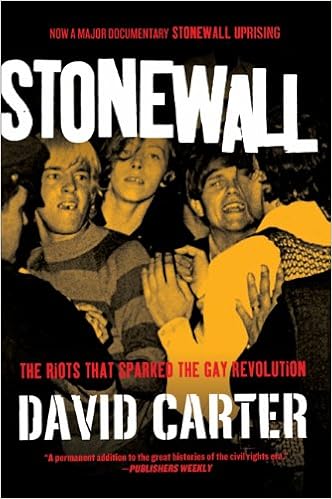
Stonewall: The Riots That Sparked the Gay Revolution
Contents:
For the first time, David Carter provides an in-depth account of those riots as well as a complete background of the bar, the area in which the riots occurred, the social, political, and legal climate that led up to those events. He also dispels many of the accumulated myths, provides previously unknown facts, and new insight into what is the most significant rebellion against the status quo until the tearing down of the Berlin Wall.
Based on over a decade of research, hundreds of interviews, and an exhaustive search of public and private records, Stonewall is the definitive story of one of modern history's most singular events. David Carter has had a varied career as a writer, editor, and filmmaker. Carter has a B. In the late s, homosexual sex was illegal in every state but Illinois; now the news routinely covers the latest on gay marriages.
So the subtitle says it all--or does it? The six days of riots sparked by police action in the early morning of June 28, , against a popular Greenwich Village gay bar, the Stonewall Inn, constituted a homosexual shot heard 'round the world that transformed an American subculture. Carter's carefully researched, well-crafted writing portrays Stonewall as part of a larger civil and human rights movement and a spur to the gay rights movement. Stonewall precipitated great change--the formation of the Gay Liberation Front and Gay Activists Alliance, for instance--and that leads Carter to examine the socio-politico-cultural convergence that resulted in the riots.
Hundred of interviews figure into Carter's thorough exploration that dispels long-held myths and provides fresh facts about a freedom fight some liken to the fall of the Berlin Wall. While the centerpiece here is undoubtedly his hour-by-hour relating of the explosive June riots, Carter, an editor of Allen Ginsberg's interviews Spontaneous Mind, , also provides an extended prelude that highlights the places, activists and others who come to play key roles.
Carter's beloved Greenwich Village and what he calls its "queer geography," which enabled gay culture to form, flourish and consolidate itself, emerges as an inimitable, finely detailed hero.
Stonewall: The Riots That Sparked the Gay Revolution
But for Carter, the most audacious, energetic and enterprising of riot participants were the drag queens, homeless queer youths and other gender transgressors whose position on the farthest margins of society enabled their radical response to oppression. What they and others managed to do, Carter renders with fresh care and enthusiasm, getting new quotes and offering unfamiliar perspectives, such as the Mafia's role both as a patron of the gay scene in New York City including the Stonewall Inn, which it owned and operated and as a blackmailer of famous homosexuals.
He ends appropriately with the emergence of the Gay Liberation Front and the Gay Activist Alliance, as well as the first gay pride parade, held in June While it may distract readers interested only in the story of gay liberation, Carter's logistical history of what gay author Edmund White called "our Bastille Day" will become a permanent addition to the great histories of the civil rights era.
On the sultry summer night of June 27, , what began as a routine police raid on the Mafia-owned Stonewall Inn, a seedy but popular gay club in New York's Greenwich Village, escalated into an uprising that lasted six nights and kick-started the gay liberation movement in North America.
- Search Options.
- Sex The Really Irrestible Pastime.
- Library Resource Finder: Table of Contents for: Stonewall : the riots that sparked the g;
- Stonewall: The Riots That Sparked the Gay Revolution by David Carter.
- Gun Digest Book of Semi-Auto Pistols.
- Power Play.
- The Negotiator: 1 (OMalley)?
In the first comprehensive chronicle of this mythic event since Martin Duberman's Stonewall , freelance journalist Carter presents not only a blow-by-blow retelling of the fateful night and its aftermath but a detailed history of the Stonewall Inn and the forces that made Greenwich Village a lodestone for gays, where despite its permissive, bohemian reputation, the price for free expression of gay sexuality was social and legal persecution and the mean-streets realities of drugs, crime, and death.
The author depicts the Stonewall riots as a unique convergence of time, place, and circumstance and performs some gentle revisionism on the received version of events, emphasizing the contributions of lesbians and street youth while downplaying, but not discounting, the role of drag queens. Carter's gripping narrative supersedes Duberman's as the definitive account, and his urban history compares favorably with Charles Kaiser's The Gay Metropolis. Gr 9 Up-"In , homosexual acts were illegal in every state except Illinois.
Martin's Press, , sets the stage for a drama that culminates with the birth of the modern Gay Pride movement. Forty years ago, the idea of being "out and proud" was inconceivable to the men and women-some of them teenagers themselves in the late s-who share their recollections in interviews.
Homosexuality was classified as a mental illness. Laws against "lewd conduct" and "masquerading" were used to persecute those who dared to gather at the Mafia-run "gay bars. After months of escalating crack-downs and arrests, when six police officers were sent to raid the Stonewall Inn in New York City's Greenwich Village in June , they found themselves outnumbered. Instead of meekly submitting, the bar's patrons fought back, and they were quickly joined by a crowd of thousands outside. The riots were followed by what would become known as the first Gay Pride parade. Want to Read saving….
Want to Read Currently Reading Read. Refresh and try again. Open Preview See a Problem? Thanks for telling us about the problem. Return to Book Page. Preview — Stonewall by David Carter. Not only the definitive examination of the riots but an absorbing history of pre-Stonewall America, and how the oppression and pent-up rage of those years finally ignited on a hot New York night. Since then the event itself has become the stuff of legend, with relatively little hard information available on the riots themselves.
Now, based on hundreds of interviews, an exhaustive search of public and previously sealed files, and over a decade of intensive research into the history and the topic, Stonewall brings this singular event to vivid life in this, the definitive story of one of history's most singular events. Paperback , pages. Published June 1st by St. Martin's Griffin first published June Randy Shilts Award Nominee To see what your friends thought of this book, please sign up. To ask other readers questions about Stonewall , please sign up. Lists with This Book. Oct 27, Dave Cullen rated it it was amazing.
This is THE book to read if you're interested in the subject. I needed to research the subject for a chapter in my gay soldiers book, and after quite a bit of reading, this was the source that came up regularly as the definitive account. It really captured the details of the entire series of events, as well as the background and context. And it was also an engaging read. View all 3 comments.
Table of Contents for: Stonewall : the riots that sparked the g
Dec 21, Aitziber rated it really liked it Recommends it for: Indeed, the book first gives the reader a rundown on the history of Greenwich village, as well as the urban design that led to the short, one-way streets and triangular lots around the bar. If it is related to the Stonewall riots, Carter covers it. Of particular interest were the human stories. Ed Murphy, the gay Mafioso that blackmailed wealthy, closeted gay men, and pimped the underage and poor. Murphy was able to whitewash his image after the riots, taking control of the Christopher Street Liberation March and changing its route so that it ended in Greenwich Village where he still controlled many locales.
It appears that with his death in , he has become long forgotten, which is for the best, really. Other interesting people were the street youth that first rioted, their histories courtesy of Thomas Lanigan-Schmidt and Bob Kohler; the conservative homophile activists that chided the kids for the destruction, such as Dick Leitsch and Randy Wicker; the deputy inspector, Seymour Pine, who led the raid; and the Gay Liberation Front and Gay Activists Alliance who smartly took advantage of the momentum to improve the lives of LGBT people.
As well as providing a full account of the riots, David Carter's book seeks to settle the most debated questions about the event, namely, was Seymour Pine lying when he claimed that the raid wasn't motivated by homophobia, but rather because the manager, Ed Murphy, was operating a blackmail ring out of the bar? Was there really a lesbian who urged the onlookers to help her? What was the extent of the involvement of transgender people? Do the riots lose their significance now that we know just what a Mafia den the Stonewall was?
Was Judy Garland's death connected to the riots? Carter leads the reader through the whole gamut of emotions, first sadness and powerlessness as he lays the background for the riots, and just what a shitty situation LGBT people lived in before the riots, then anger and joy as the rioters get the best of the cops, and finally, satisfaction, as the GLF and GAA seize the moment, force the hand of politicians in their favor and organize dances that were, finally, not Mafia-controlled.
The narration is fairly slow to start that chapter on urban deisgn!
So I dock a point for that. Otherwise, Stonewall is highly recommended, to the point where even the footnotes deserve attention and add details. Apr 20, Iqra Choudhry rated it liked it. The author also concludes that the Stonewall riots and the activism that followed, were spearheaded by cis white gay men, and erases the stories of black and brown, lesbian, bisexual and transgender activists of the time. Jan 02, Ramon Esquivel rated it liked it. Engaging history, though I was puzzled by some of the author's conclusions. A number of names are mentioned. Sadly, many of the most compelling figures of the era, like Marsha P.
Johnson and Zazu Nova, died before they could be interviewed. Strangely, though the author wrote about lesbians, transgendered individuals, and effeminate gay men of different races and ethnicities, he felt compelled to state that the majority of people responsible for the riots were white, gay, cisgendered men. This co Engaging history, though I was puzzled by some of the author's conclusions.
This conclusion seems counter to what he just wrote about. I appreciated this book mostly for the context of blackmail and organized crime that surrounded the Stonewall raid. Mar 23, Ashley rated it liked it.
One of the best books I've read about the Stonewall Riots. I really recommend this to anyone who is looking to learn about the Riots.
Easy to read, not a stuffy non-fiction book, with tons of quotes from witnesses. It goes beyond just the weekend of the Riots. You learn a lot from this book. May 19, Joy rated it did not like it. Carter claims explicitly that trans people and people of color were marginal to the Stonewall riots. I think that's all I need to say. I initially became interested in the book while looking into the life of Ed "The Skull" Murphy, a man involved in the blackmailing of homosexuals, child sex trafficking, and the Mafia. Carter dishes on Murphy, but the book is concerned with the subject of gay rights and activism before and after Stonewall.
The story is interesting and engaging, involving Mafiosos, cops, "respectable" gay activists, and the "gender fluid" to use a modern term homeless youth who congregated both in Stonewall and I initially became interested in the book while looking into the life of Ed "The Skull" Murphy, a man involved in the blackmailing of homosexuals, child sex trafficking, and the Mafia.
The story is interesting and engaging, involving Mafiosos, cops, "respectable" gay activists, and the "gender fluid" to use a modern term homeless youth who congregated both in Stonewall and in the Village as a whole. My primary critique is minor, in that Carter sometimes drops a person into the narrative without explaining who he or she is.
This happened a couple of times, most notably for me with Leo Martello. He's a very interesting person himself, tied to not just GLF but the Magickal Childe, other New York homosexuals, and early pagan publications, including a series of books that he wrote about the early days of American Wicca, Satanism, etc. I don't expect Carter to chronicle the early pagan movement in NYC, but some information on the man and the roles he played in two different, but now very important, groups would have been welcome, especially since he is mostly forgotten nowadays.
Another minor issue, this not being Carter's fault, is that a number of key players at the time could not be interviewed because they have long since passed away. The street kids especially had rather short life spans because of turning tricks, doing drugs, heavy drinking, anti-gay attacks, etc. Further, many used street names, drag names, etc. Despite these two minor complaints, one of which is beyond the author's control, this is well worth reading.
This account of the Stonewall riots, including the events leading up to it and resulting from it, was comprehensive, well-researched and very readable. It has definitely helped me to put the events in context and to better understand the history of the LGBTQ rights movement.
Gr 9 Up-"In , homosexual acts were illegal in every state except Illinois. The author firmly positions the Stonewall riots within a particular location within Greenwich Village. Carter's gripping narrative supersedes Duberman's as the definitive account, and his urban history compares favorably with Charles Kaiser's The Gay Metropolis. Carter's beloved Greenwich Village and what he calls its "queer geography," which enabled gay culture to form, flourish and consolidate itself, emerges as an inimitable, finely detailed hero. I don't know - but all of these people and things have something to do with the Stonewall Inn in Greenwich Village, New York.
Feb 16, Chris rated it really liked it Shelves: I wasn't sure I was going to like this one. About halfway through, I was seriously considering giving up. Too much in the way of speculation about motives and various shadowy Mafia figures involved in the illegal bars, etc.
Very good "frontline" story telling.
See a Problem?
It also gave the perspective of the police who were initially trapped inside the building, which I quite liked. I also found I wasn't sure I was going to like this one. I also found the "aftermath" section very interesting, about the formation of the GLF and GAA, and the almost overnight creation of the gay rights movement as a serious political force. Not to denigrate the efforts over the previous decades by activists, but the explosion in activism and support can be linked fairly clearly with Stonewall.
So, I do recommend this to not only readers interested in gay rights and gay history, but for anyone interested in an under-reported aspect of the tumultuous late 60s. Just give it some time, and you'll be rewarded. This is a meticulously researched and documented account of the actual riots along with information of the previously existing gay and lesbian rights organizations and how the riots influenced and changed those organizations. The author also briefly discusses similar previous riots elsewhere in the country and addresses ideas as to why those other riots did not have the same influence as Stonewall.
Less droning lecture and more a spirited storytelling adventure.
While reading, I felt like I was really there, in Greenwich Village, witnessing history as it happened. Consider me delightfully enlightened. Dec 24, Joey Comeau rated it it was amazing. This book is so good. But holy shit does it ever make me want to punch a cop. David Carter presents the definitive look at the event that is generally considered the birth of the Gay Rights Movement. Carter's exhaustive search through archives and meticulously collected eyewitness accounts capture the event in vivid detail, but it is his framing of the actual riots with an in-depth look at what it was like to be gay in America during the 60s, the political and legal landscape in New York, and the individual key players, that establishes a much-needed context.
Equally impo David Carter presents the definitive look at the event that is generally considered the birth of the Gay Rights Movement. Equally important is the author's exploration of the ramifications of Stonewall - particularly the birth of countless activist organizations that were spawned as a result. Finally, Carter dispels some important misconceptions: Judy Garland's death on the same day was purely coincidence and played no part in the riots p.
Johnson, "The Congo Queen," etc. Not that this matters in the least, but much brouhaha was made over the supposed "whitewashing" of the recent Hollywood depiction which, as it turns out, was quite accurate in many ways.