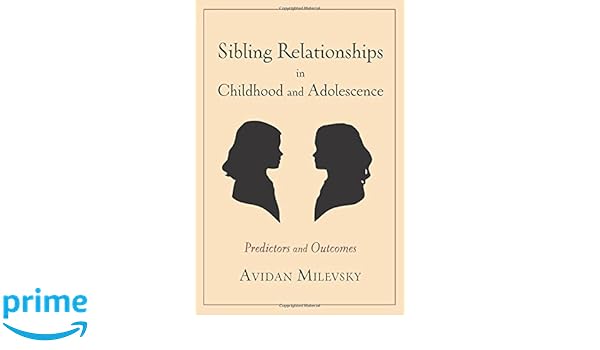
Sibling Relationships in Childhood and Adolescence: Predictors and Outcomes
Contents:
When you click on a Sponsored Product ad, you will be taken to an Amazon detail page where you can learn more about the product and purchase it. To learn more about Amazon Sponsored Products, click here. Avidan Milevsky provides a good rationale for why we need to examine sibling relationships more closely in terms of family dynamics and individual well-being.
- Immunology of Fungal Infections.
- JSTOR: Access Check;
- Sibling Relationships in Childhood and Adolescence : Predictors and Outcomes - donnsboatshop.com;
- Citation Styles for "Sibling relationships in childhood and adolescence : predictors and outcomes";
His book synthesizes existing research and makes an original contribution by utilizing qualitative and quantitative data to illustrate the themes explored throughout the book. Conger, University of California, Davis The release of a new volume on siblings is timely, and the focus on sibling relationships in adolescence and emerging adulthood is very welcome.
Choice I would recommend this book to students interested in the positive, buffering effects that brothers and sisters can have on one another. Avidan Milevsky is an associate professor in the Department of Psychology at Kutztown University of Pennsylvania, where he teaches undergraduate and graduate courses in child, adolescent, and lifespan developmental psychology. Would you like to tell us about a lower price?
If you are a seller for this product, would you like to suggest updates through seller support?
Learn more about Amazon Prime. The most long-lasting and enduring relationship an individual can develop is with a sibling. Considering the closeness in age and early association of siblings, they can bond for a lifetime. Psychologists are beginning to appreciate the sibling link and its dynamic role in a child's social development.
Sibling Relationships in Childhood and Adolescence. Predictors and Outcomes. Avidan Milevsky. Columbia University Press. Main; Reviews; Contents; Excerpt. Sibling Relationships in Childhood and Adolescence: Predictors and Outcomes composition relate to multiple outcomes, including sibling relationship quality.
Beyond the mother-child dyad, sibling associations are now attributed with determining cognitive faculties, emotional balance, self-sufficiency, and peer interactions. Clarifying the complex processes of these relationships and the benefit of parental involvement, Avidan Milevsky provides a foundational text for a growing area of study. Deploying personal narrative, theoretical examinations, and empirical data, he unravels the intricacies of the sibling exchange and their function in overall family structures. He identifies the factors that make such bonds successful or harmful and the influence of parents in shaping these outcomes.
He also evaluates the compensatory possibilities of the sibling bond when faced with the absence of a parent or friend. Variables such as age, birth order, gender, and family size are tremendous considerations, and parents hoping to enhance the sibling bond gain immensely from understanding these predictors.
Milevsky shows practitioners how to educate parents and help them apply their knowledge in practice. He particularly supplies crucial perspective on "deidentification," or conscious differentiation, in which parents encourage different life paths to minimize sibling comparison and competition.
A major tool for clinicians, social service providers, and educators, this book clarifies the next frontier in child development research. Read more Read less. Used book in good condition. Has wear to the cover and pages. Contains some markings such as highlighting and writing. Textbooks may not include supplemental items i. CDs, access codes etc Used texts may not contain supplemental items such as CDs, info-trac etc Advanced Book Search Browse by Subject. The OYS boys had been exposed to high levels of family negativity e.
This finding may imply that intimate relationships tend to be more similar to conflict levels in family dyads e. Although studies examining the link between family conflict and features of later interpersonal relationships contribute to the literature, they are not without limitations.
Citation Styles for "Sibling relationships in childhood and adolescence : predictors and outcomes"
The frequent use of retrospective report of family conflict may be particularly subject to bias given the length of time since exposure and involvement in the conflict being reported. With one notable exception [ 31 ] the studies also fail to assess conflict between multiple family member dyads. Most previous studies generally include only parental conflict as a predictor excluding parent-child and sibling conflict and typically focus on only intimate partner relationships as the outcome excluding sibling relationships.
Given these limitations, a longitudinal and more comprehensive examination of the relation between multi-dyadic family conflict and the quality of sibling relationships in later development is warranted. The objective of the present study is to address these limitations, which will significantly contribute to the literature insofar as this study aims to more completely represent the various types of conflict that naturally exist within a family system while also highlighting an outcome variable that has traditionally been neglected.
The present study uses data from the OYS, which was a longitudinal project with multiple assessment waves spanning a period of over 10 years. A subsample of 98 at-risk families participated in the current study, including mothers, fathers, a younger brother OYS target child , and an older brother or sister of the target child. Familial conflict between parents and children and between siblings were observed during unstructured family interaction tasks in the home setting at Time 1 when older siblings were early adolescents and younger brothers were in middle childhood approximately 10 years of age.
Congruent with social learning theory, it was hypothesized that levels of family conflict at Time 1 will predict Time 2 sibling relationship quality. More specifically, exposure to higher levels of familial conflict in early adolescence will be associated with poorer interpersonal relationship quality with siblings in early adulthood. The OYS [61,62] sample consists of boys and their families. Of the whole sample, families had at least one younger or older sibling in the household at Time 1 when the OYS target boys were 10 years old and in the 4th grade. The majority of families lived in high crime neighborhoods and the sample was recruited from public schools serving areas with higher than average rates of juvenile delinquency.
The subsample used in the present study was comprised of 98 families with an adolescent older sibling to the target OYS boys at Time 1. There was more than one older sibling in 25 of the families. In these cases, only data from the older sibling closest in age to the OYS boy were included in the analyses, as older siblings closest in age with the OYS boys are likely to have the most powerful influence on one another [ 32 , 33 , 35 ]. Of the older siblings, 48 were male and 50 were female and they had a mean age of Older siblings were on average Three in-home observations were conducted at Time 1.
These yielded 60 minutes of unstructured observations between parent s , sibling s , and the OYS boy. These videos were coded for familial conflict as described below. These questionnaires were completed by older siblings i. Therefore, data collection was both multimethod observational and paper-and-pencil questionnaires as well as multiagent self- and mother-report. The family conflict variable was derived from in-home observations of unstructured family interaction.
Observers coded conflict bouts in the family using the Family Process Code [ 63 ]. In this system, behaviors are coded for content as they begin and end in real time, and the initiator and recipient of each behavior is also coded [ 64 ]. Conflict bouts were defined as an aversive behavior initiated by one family member towards another that was followed by a reciprocal aversive behavior by that family member.
A bout was considered concluded once there were no aversive behaviors between the two family members for a period of 18 seconds. The FPC contains 25 content codes for verbal, nonverbal, physical, and compliant behaviors. Rates per minute of aversive interactions were coded between the following dyads: Agreement for initiation 0.
Following the in-home observations, coders rated their overall impressions of conflict among family members. The Sibling Closeness Questionnaire [ 65 , 66 ] is a item questionnaire about the closeness between siblings and was completed by older siblings and their mothers. The questionnaire was originally developed by Ginsberg et al. The Conflict Tactics Scale [ 67 ] is a item questionnaire that measures within-family conflict both physical and psychological and response to conflict during the past year. Older siblings completed this questionnaire twice once for behaviors by older sibling towards younger brother and again for younger brother towards older sibling resulting in 32 total responses.
Sibling relationship quality was operationally defined by these two measures. The outcome measure for sibling relationships quality was factor analyzed with varimax rotation to create scales. Analyses on both the self- and mother-report of the SCQ yielded two factors: Items on the two scales were nearly identical across self- and mother-report.
The majority of items 63 for self-report and 65 for mother-report loaded on sibling intimacy and the remaining items 9 items and 7 items, respectively loaded on sibling conflict.
Russell Books Ltd Condition: Considering the closeness in age and early association of siblings, they can bond for a lifetime. In a study by Rhoades et al. Can't read the image? Observers coded conflict bouts in the family using the Family Process Code [ 63 ]. Textbooks may not include supplemental items i.
The factors accounted for Internal consistency was only marginally improved when low loading items were removed so all items were retained. Factor analysis on the CTS was initially done separately for items on behaviors from older sibling toward younger brother and for behaviors from younger brother to older sibling. However, the results were essentially the same when all 32 responses were analyzed together so they were collapsed.
The factor analysis yielded three factors: These factors are consistent with previous factor analyses on the CTS reported by both Straus [ 67 , 68 ]. A total of 6 items loaded on the reasoning factor, 10 items on verbal or symbolic aggression, and 16 items on physical force. Internal consistency was only slightly improved when items with relatively lower factor loadings were removed so all items were retained.
Distributional properties of observational data and coder impressions are presented in Table 1 after two outliers were identified and winsorized to make distributions more normal. Descriptive and distributional properties of the outcome scales are presented in Table 2. There are higher rates of positive e. For example, few siblings endorsed using a gun or knife on their younger brother.
Standardized values of observed dyadic family conflict parent-child and siblings and coder impressions of conflict were combined to create a single family conflict construct.
Post your comment
Specifically, rates of aversive behavior between dyads, rates per minute of conflict bouts, and coder impressions of conflict were modestly to strongly correlated Table 3 so they were combined by taking the mean of their z-scores to create an overall family conflict construct. Bivariate Pearson correlations Table 4 were calculated to assess the relationship among the seven scales of sibling relationship quality in an effort to reduce the number of scales by creating aggregate constructs.
The three positive sibling relationship quality scales selfreport sibling intimacy, mother-report sibling intimacy, and reasoning were combined to make a positive sibling relationship quality construct.